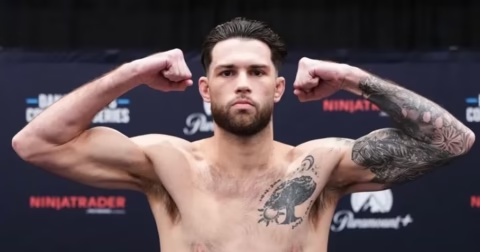
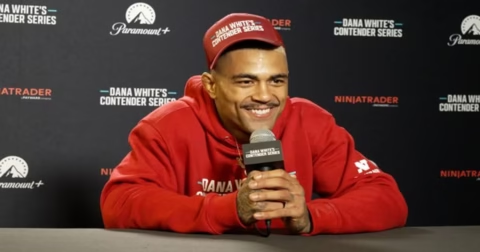
Training with Jake Paul isn’t for the faint-hearted, according to professional boxer Anthony Taylor. In a revealing new interview on Overdogs Podcast, Taylor has detailed the stringent, no-nonsense environment in Paul’s camp, where sparring partners are swiftly dismissed if they fail to meet the influencer-turned-fighter’s exacting standards.
“The expectations are crystal clear,” Taylor explained. “You’re there to work, to push him, to simulate a real fight. If you’re not bringing that from the first bell, you’ll hear him say, ‘I’m sending you home.'” This demanding approach offers a rare glimpse into the work ethic driving Paul’s much-discussed transition into boxing.
A “Survival of the Fittest” Camp Atmosphere
Taylor, who is currently preparing for his own high-profile MMA bout against Dillon Danis, described a pivotal moment during one of Paul’s training camps. After observing a series of sessions, Paul gathered his team of sparring partners.
“He looked at us and just laid it out,” Taylor recalled. “He said something like, ‘Some of you aren’t giving me the work I need. You’re not efficient. You’re not pushing the pace.’ Then he pointed at a few guys and told them they were done. Just like that.”
According to Taylor, only one partner from that initial group was retained—the one who consistently provided the intense, competitive rounds Paul demanded. “It’s a survival of the fittest mentality,” Taylor noted. “He doesn’t have time for partners who are just there for a payday. He needs people who will force him to improve.”
Reflecting on Paul’s Rapid Evolution
Having sparred with Paul multiple times a week in the lead-up to various fights, Taylor has had a front-row seat to the 27-year-old’s development. He acknowledges a significant leap in Paul’s technical ability and ring IQ since his early bouts against fellow influencers and retired MMA fighters.
“The Jake Paul preparing for a fight now is completely different from the guy who fought Ben Askren,” Taylor stated. “His footwork, his defence, his punch selection—it’s all levelled up. And a lot of that comes from creating a training environment where he’s constantly challenged.”
Taylor believes this ruthless curation of sparring partners, while seemingly harsh, is a key factor in Paul’s ability to compete against increasingly professional opposition. “It shows he’s not playing at this. He’s treating it like a top-level athlete should. He’s investing in himself by demanding the best from everyone around him.”
Mindset for Upcoming Challenges
As Taylor shifts his focus to his own combat sports career, he credits the discipline witnessed in Paul’s camp with reinforcing his own professional standards. The experience has underscored the universal truth in fight sports: to beat the best, you must train with the best—and sometimes, that means making tough decisions to maintain a high-performance ecosystem.
“It’s a business at the end of the day,” Taylor concluded. “Jake’s approach might seem cutthroat, but in this game, you can’t afford to have anyone in your circle who isn’t helping you get better. Sometimes that means sending people home.”